
Shopping for a fence usually starts the same way. You are trying to solve a real-life problem. Keep the dog in. Keep strangers out. Protect equipment. Give tenants peace of mind. And you want it to look right while you are at it.
That is where the decision between commercial vs residential fencing matters. It is not just a pricing difference. It is a performance difference. The right choice affects security, safety, code compliance, long-term durability, and how smoothly your property runs day to day.
Whether you manage a business site, own a multifamily property, or are updating a home perimeter, this guide breaks down what matters most in a clear, practical way.
It starts with the job the fence needs to do
Residential fencing is usually built for lifestyle. Homeowners want privacy, curb appeal, and clear boundaries for kids and pets. Gates are opened a few times a day, and the fence rarely faces constant traffic or heavy impacts. That is why residential systems often prioritize appearance and affordability.
Commercial fencing is expected to do more, and do it for longer. It may be protecting inventory, equipment, vehicles, staff areas, or tenant spaces. It often helps control access, guide traffic flow, and support surveillance. On commercial properties, openings and gates are used constantly, and that repeated use is exactly why commercial systems are built with heavier components and stronger hardware.
Materials may look similar, but the build quality is not
From the street, a residential chain link fence can resemble a commercial chain link fence. The difference is usually in the details that hold up over time. Residential systems commonly use wood, vinyl, ornamental aluminum, or lighter chain link with standard posts and fittings.
Commercial fencing typically steps up the spec. You will often see heavier gauge chain link, welded wire panels, ornamental steel, and security-focused designs intended to discourage climbing or cutting. Even when the style looks similar, commercial grade construction usually means thicker posts, stronger rails, reinforced bracing, and hardware designed to handle high-cycle daily use without sagging or failing early.
Height and layout are driven by security and site planning
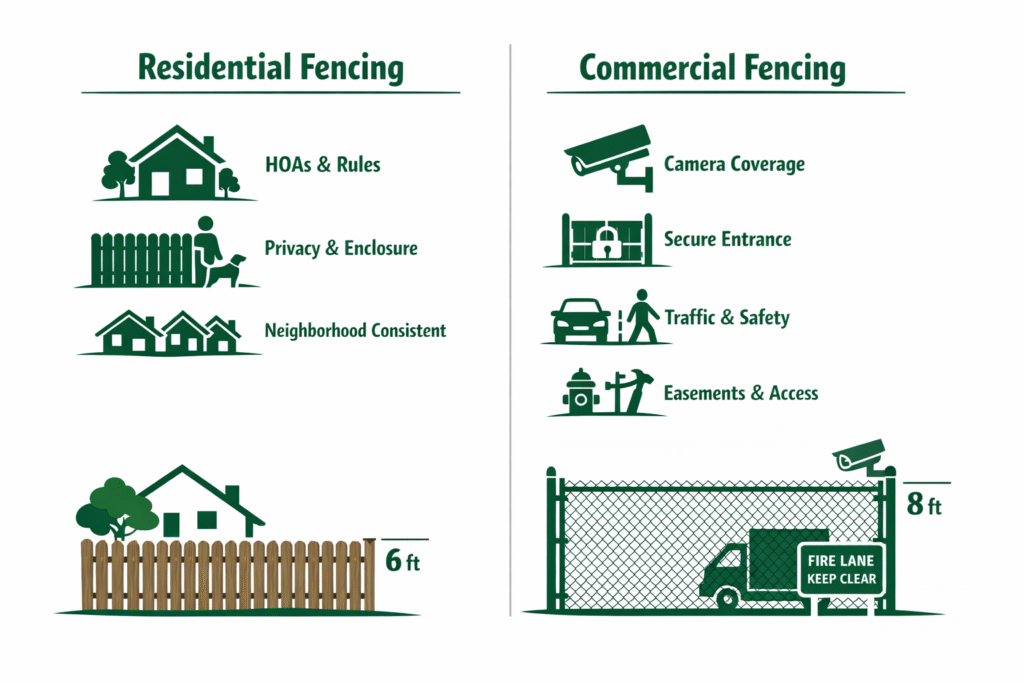
Residential fencing is often shaped by neighborhood rules, HOAs, and local ordinances. The goal is typically privacy or enclosure while keeping the fence consistent with the surrounding neighborhood.
Commercial fencing is planned around risk, visibility, and operations. Height is often higher, and placement decisions consider camera lines of sight, controlled entry points, and separation between pedestrians and vehicles. Commercial sites also have to account for easements, utilities, fire lanes, and service access. A commercial fence is rarely just a border. It is part of how the property functions.
Compliance requirements are usually higher for commercial sites
This is where many property owners get surprised.
Residential fencing most often needs to follow local rules on height, placement, and in many areas pool barrier requirements. It matters, but it is usually straightforward.
Commercial properties can face additional layers of requirements. Building and fire codes can affect where fencing can be installed, especially near exits, fire lanes, and equipment access. Gates on accessible routes may need to meet accessibility expectations. And if you are using automated gates, safety measures and proper installation are essential to reduce liability.
If code compliance is part of your decision, it is worth treating the fence as a system, not a standalone product.
Durability is not just lifespan, it is downtime
Residential fences can last a long time, but maintenance is expected. Wood needs sealing or staining. Hinges loosen. Soil shifts and sections can lean. Most homeowners can tolerate gradual wear as long as the fence still looks good and works well enough.
Commercial fencing is expected to keep performing with minimal interruptions. When a gate fails at a busy property, it can create security gaps, operational delays, and tenant frustration. That is why commercial systems often use corrosion-resistant finishes, stronger footings, and heavy duty hardware designed for frequent use.
Over time, the better question is not just, “How long will it last?” It is, “How often will it need repairs, and what does downtime cost the property?”
Gates and access control separate commercial vs residential fencing even more
Residential gates are typically simple, with a latch or basic keypad for convenience.
Commercial gates are often managed entry points. Many sites need controlled access for staff, tenants, vendors, and visitors, and may integrate card readers, keypads, mobile credentials, intercoms, vehicle detection, and camera coverage. When automation is involved, safety features and professional installation are critical.
If your fence includes automation or access control, you are no longer choosing just a fence. You are choosing a security perimeter.
So which one should you choose?
If your fence is mostly about privacy, curb appeal, and lighter daily use, residential grade fencing can be a good fit. If the fence is tied to security, compliance, liability, or daily operations, commercial grade construction is usually the smarter investment, even for smaller properties like multifamily communities or light commercial sites.
A simple way to decide is to picture the property five years from now. If you expect more traffic, more gate cycles, more tenants, or more security expectations, it pays to choose materials and hardware that can keep up.
Bring in a team that understands Texas fences
Texas weather is tough on fencing. High heat, hard sun, sudden storms, and shifting ground can expose weak materials and shortcuts fast. Penco designs and installs fencing systems built for the Texas weather and lifestyle, whether that means a clean residential perimeter, a high-cycle commercial gate, or a secure solution that ties into access control.
If you want help choosing the right approach for your property, Penco can recommend a system that fits your needs and install it the right way from day one.
Key Takeaways
- Commercial vs residential fencing comes down to performance, not just appearance.
- Residential fencing typically focuses on privacy, curb appeal, and lighter use.
- Commercial fencing is built for security, higher traffic, and long-term durability.
- Commercial grade systems usually include heavier posts, stronger hardware, and tougher finishes.
- Compliance and safety requirements can be more complex on commercial properties, especially with automated gates.
- Downtime and repairs often cost more than the upfront price difference.